Is Your AC the Right Size? A Homeowner's Guide
Is Your AC the Right Size? A Homeowner's Guide
If your home never cools down evenly or feels damp even when the AC is running, the system itself may not be broken — it may just be the wrong size. This article breaks down the two failure modes of improper AC sizing, explains how systems should actually be sized, and walks Sonoma County homeowners through the local factors that make this issue especially common in their area.
Key Takeaways
- An undersized AC runs constantly without reaching your target temperature, creates hot spots, and wears out faster from the nonstop strain.
- An oversized AC short-cycles — shutting off before completing a full cooling cycle — which leaves humidity in the air and puts premature wear on the compressor.
- Proper sizing requires a Manual J load calculation that accounts for ceiling height, insulation, window placement, sun exposure, and household size — not just square footage.
- Sonoma County's climate variability (intense inland heat vs. cooler coastal zones) and older housing stock mean local homes have uniquely complex sizing needs.
- If the same comfort problems keep returning season after season, a professional sizing evaluation may be more useful than another repair.
If your home never quite cools down on a hot summer day or feels damp and clammy even when the AC is running, you might assume your unit is broken. But sometimes the problem isn't a failing part. It's a bad fit. An air conditioner that's the wrong size for your home will struggle no matter how well it's maintained. Here's how to know if your AC is the right size.
Why Does AC Size Even Matter?
An air conditioner's capacity is measured in BTUs (British Thermal Units) or "tons," which describe how much heat the system can pull out of your home per hour. A properly sized system will run in long, steady cycles, cooling your space evenly and removing humidity from the air along the way.
When the AC unit's size is off, it can't work efficiently. Depending on which direction the mismatch goes, you'll end up with a home that never cools down enough or one that feels strangely muggy and uncomfortable. Either way, your energy bills and repair costs tend to climb.
What Are the Signs Your AC Is Too Small?
An undersized AC has to work harder than it should, often running nonstop without ever reaching the temperature on your thermostat. If your system runs for hours without results, especially during peak heat, that's a red flag.
Other common signs that your AC is too small include:
- Hot spots in rooms farthest from the unit
- Higher-than-expected energy bills
- Frequent repairs from a system that's constantly overworked
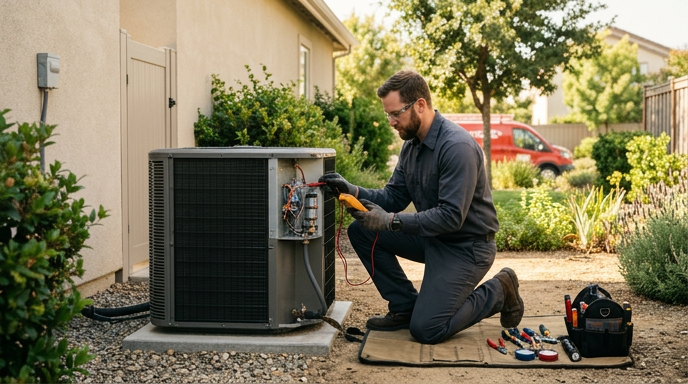
When an AC is always straining to keep up, it wears out faster and breaks down more often. A professional AC service visit can rule out simpler fixes, such as a clogged filter or low refrigerant. But if the same problems keep returning, unit sizing may be the root cause.
What Are the Signs Your AC Is Too Big?
Bigger isn't better when it comes to air conditioning. An oversized system cools your home so quickly that it shuts off before finishing a full cycle. This problem is called "short cycling." Instead of running steady 15- to 20-minute cycles, the system kicks on and off every few minutes.
Short cycling creates two big problems. First, the system never runs long enough to pull humidity out of the air. Your home may read a comfortable temperature on the thermostat but still feel sticky and muggy in person.
Second, all those starts and stops put serious wear on the compressor, which is one of the most expensive components in your system. You may also notice uneven temperatures from room to room, since the air isn't circulating long enough to spread evenly through your home.
How Is the Right AC Size Determined?
The industry-standard method for sizing an air conditioner is called a Manual J load calculation. This goes far beyond simply measuring square footage. A proper Manual J calculation accounts for:
- Ceiling height and overall home layout
- Window size, placement, and insulation quality
- Existing insulation in walls, floors, and the attic
- Sun exposure, shading, and the direction the home faces
- The number of people living in the home
Unfortunately, some contractors skip this step and rely on rough estimates instead. That approach often results in a system that was improperly sized from day one. If you're turning your AC back on each summer and still running into the same comfort complaints, it may be worth asking whether your system was ever correctly sized in the first place.
Why Do Sonoma County Homes Have Unique Sizing Needs?
Sonoma County isn't a single, uniform climate. Inland communities like Santa Rosa and Windsor can see intense summer heat waves, while coastal areas near Bodega Bay stay much cooler thanks to ocean air. In other words, a home in Rohnert Park has very different cooling demands than one just 20 miles west, even if the two houses are the same size on paper.
Older homes add another layer of complexity. A large portion of Sonoma County's housing stock includes older construction with varying insulation levels, original windows, and ductwork that wasn't built with modern AC systems in mind. These homes often lose conditioned air through gaps and cracks, which directly affects how hard any system has to work and what size the AC unit needs to be.
Staying current on spring HVAC maintenance can uncover some of these efficiency issues, but if comfort problems keep coming back season after season, getting a professional sizing evaluation is the logical next step.
Getting a Properly Sized AC Starts With Next Level HVAC
If your AC consistently runs nonstop, short cycles, or leaves your home feeling muggy no matter what you do, the smartest move may be AC replacement. But before getting a new unit, you need an honest evaluation of what's wrong with your system.
Next Level HVAC serves Marin and Sonoma County homeowners with straightforward assessments and practical guidance. Our team can inspect your current unit, explain what's causing the issue, and help you decide whether repair, maintenance, or replacement makes the most sense.
Browse our cooling services or contact us today to schedule an evaluation with a skilled technician from Next Level HVAC.
Share
More Posts That Might Interest You